Nearly everyone in the world uses electricity every day, but not many people think much about it. You turn on the light switch and the lights work. Is that a 60-watt bulb or 100 watts? More watts means brighter, right?
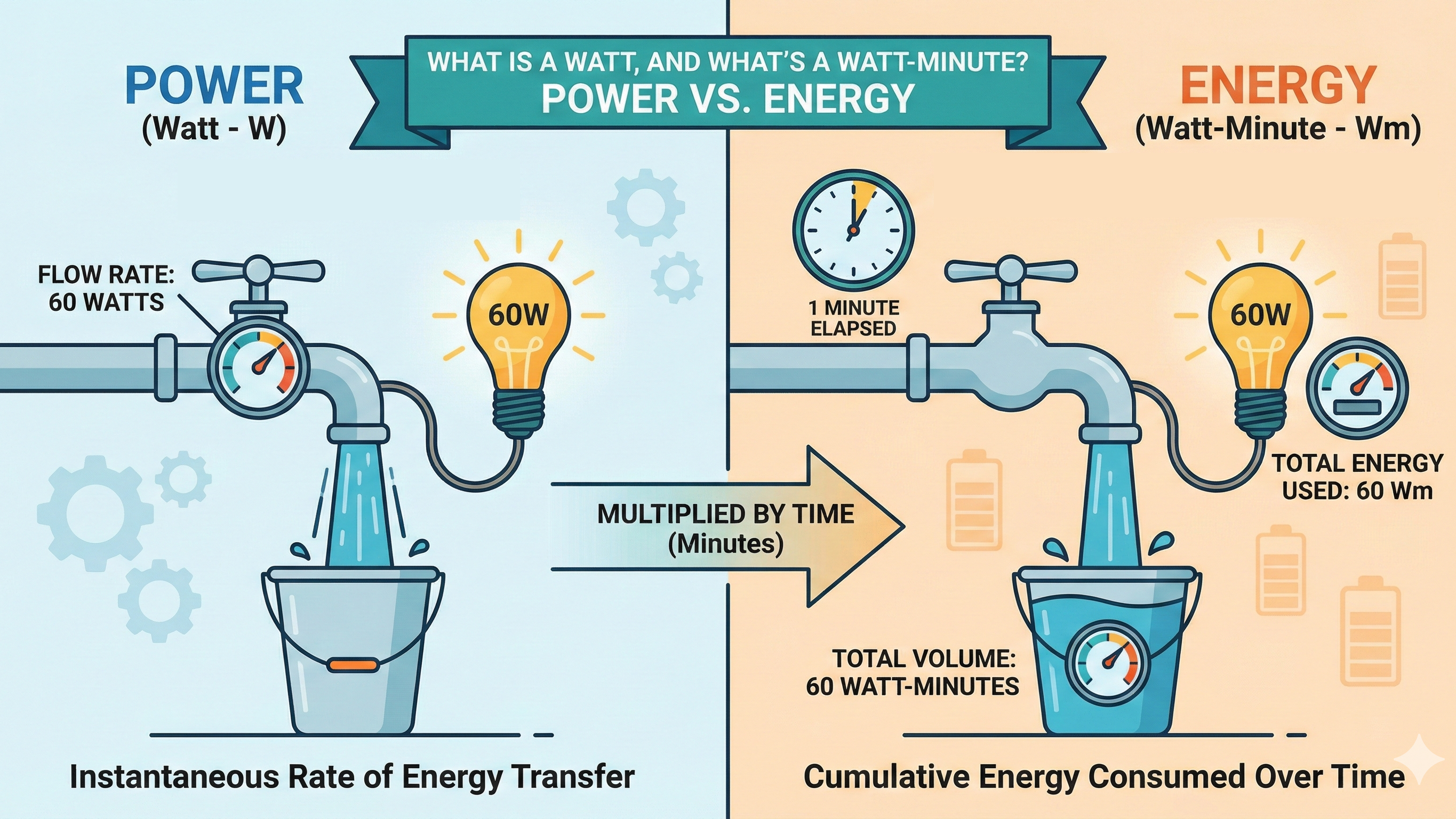
A watt is a measure of electrical power, which means the flow rate of electricity. It’s kind of like “miles per hour” in your car or “gallons per minute” from your shower head, except this is “charged electrons per second” flowing in a circuit.
You might be surprised to learn that even when we’re talking about one watt, we’re talking about a LOT of electrons. 6.24 quintillion, to be exact. That amount of charged electrons is called a “coulomb” (which rhymes with “cool mom”).
It’s pretty annoying to talk about such big numbers, so we stick to watts.
Watts vs. watt-hours (and watt-minutes)
Going back to the lightbulbs, the 100-watt version requires more power (i.e. a higher electricity flow rate).
But the power rating is just one side of the equation — it only covers instantaneous flow. When you have the light bulb on for a while, the energy in those charged electrons gets used up.
Energy is the total number of electrons that get used up when powering an electrical circuit over time. Energy is measured in watt-hours.
To return to the water metaphor, if you ran your faucet at a flow rate (or “power”) of 1 gallon per hour, the “energy” you got would be all the water that flowed into a gallon bucket over that time.
To calculate watt-hours, you multiply the power draw of the device by the amount of time it has run.
For example, if you had a 60-watt light bulb on for an hour, you have used 60 watt-hours of energy. But if you turned it off after, say half an hour, you would only use 30 watt-hours.
And you can do this with watt-minutes as well. If you have the 60-watt lightbulb on for only 10 minutes, that’s 600 watt-minutes (60 watts x 10 minutes = 600 watt-minutes).
You can convert it to watt-hours by dividing by the 60 minutes in an hour (600 watt-minutes ÷ 60 minutes in an hour = 10 watt-hours). Math is fun!
Quick recap: power vs. energy
The two main concepts of electricity are power and energy.
- Power is the flow rate of electricity, and it is measured in watts
- Energy is the total amount of electricity used, and it is measured in watt-hours.
To get watt-hours, you multiply the watts of power used by the time you used it for.
By the way, when we’re talking about electricity, watts get the symbol “W” and watt-hours get the symbol “Wh” (the W capitalized because it’s named after James Watt, an inventor who created steam engines — seriously!).
Kilowatt-hours and the cost of energy
Okay, here’s where we start talking about the real world and introduce a character you really need to know: the kilowatt-hour, or kWh for short.
The reason you need to know the kWh is because she’s famous—literally everybody gets pieces of paper with her name on them in their mail every month.
That’s because your electric utility sends you a bill for the number of kWh you pull from the grid every month.
And oh boy, do we love to use electricity! The average American home uses about 900 kWh of energy every month. At an average cost of 17 cents per kilowatt-hour, the average American household pays about $150 for electricity every month!
What to do with this knowledge
The first thing you can do with this knowledge is go read your electric bill! Find out how much you’re paying for every kWh, and see how many kWh you’re using.
Is your bill higher than $150? You pay more than average!
Of course, household energy usage and prices for kWh vary widely across the country. For example, in California, the average household uses just 640 kWh per month, but the prices there are so high (almost 30 cents per kWh!) that the average bill is about $190.
Another thing you can do with this knowledge: examine your own usage of electricity!
Many people don’t think about their electric bill much at all, treating it like something that just happens every month. But it doesn’t!
The choices you make every day go into how much you pay for electricity at the end of the month. By looking at how you use electricity, you can start to make better choices, saving yourself some good money!
Watts and watt-hours in portable batteries
One of our favorite reasons to know about watts, watt-hours, and kilowatt-hours is to understand how portable batteries work. These batteries allow you to store and use electrical energy, and you can recharge them using your wall outlet or even a portable solar panel!
You’ve probably seen these batteries around, or you might even have one yourself. Popular brands like Bluetti, EcoFlow, and Jackery offer batteries of all different shapes and sizes.
Here’s where power and energy come in: Every battery is designed to output power up to certain number of watts, and each one has a certain kWh capacity of energy.
Know what you want to power, and how long you want to power it is essential in deciding which portable solar battery is right for you. You’ll want to pick the right mix of power output and energy storage.
For example, if you need to run an electric kettle, you’ll need as battery with a maximum continuous power output greater than the 1,500 W needed to run it. If you know you’ll need to use it for an hour on a camping trip, you’ll need to make sure the battery capacity is at least 1,500 Wh (or 1.5 kWh).
Realistically, you’ll want to choose a battery capacity that is a bit larger than what you need to account for losses due energy conversion efficiency. But knowing the basics will give you a good idea.
Biggest energy users in the home
If you’re a parent, you might spend a lot of time complaining that your kids left the light on in the bathroom again, but it probably isn’t that big of a deal (that doesn’t man they get to talk back, though).
The electrical appliances that use the most energy in your home are heaters, ovens, clothes dryers, and dishwashers. These appliances contain resistive heating elements, meaning they literally have big fat wires that trap electricity and convert power into heat.
The key with these appliances is they use a ton of power, and because they often run for long periods of time, they also use lots of energy. The average oven uses 3,000 W of power, so if it’s on for an hour, that’s 3 kWh.
So if you pay the average 17 cents per kWh of energy, baking some delicious mac and cheese will cost you 51 cents! Doing it every day costs you $15 a month, or 10% of the average electric bill.
Other appliances use a ton of power, like your coffee maker, toaster, or microwave oven, but they only run for a few minutes at a time. If it takes 3 minutes to toast a bagel in a 1500W toaster, that’s only 75 watt-hours. Toasting all the bread you eat in a month will probably cost you less than a dollar.
Back to leaving the light bulbs on: if you have any of those 60- or 100-watt light bulbs, get rid of them! Incandescent bulbs are also resistive, with a metal strip or coil inside that produces a warm glow, but also a lot of waste heat. It’s sort of the same as an electric oven or dryer, but the metal in the bulb gets much brighter than the dull red-orange glow of an oven heating element.
If you have any of those, maybe griping at your kids is justified, but you should really replace them with new LED light bulbs, which draw an average of between 8 and 15 watts of power.
With a house full of LED bulbs, you can have your lights on whenever you feel like it!
